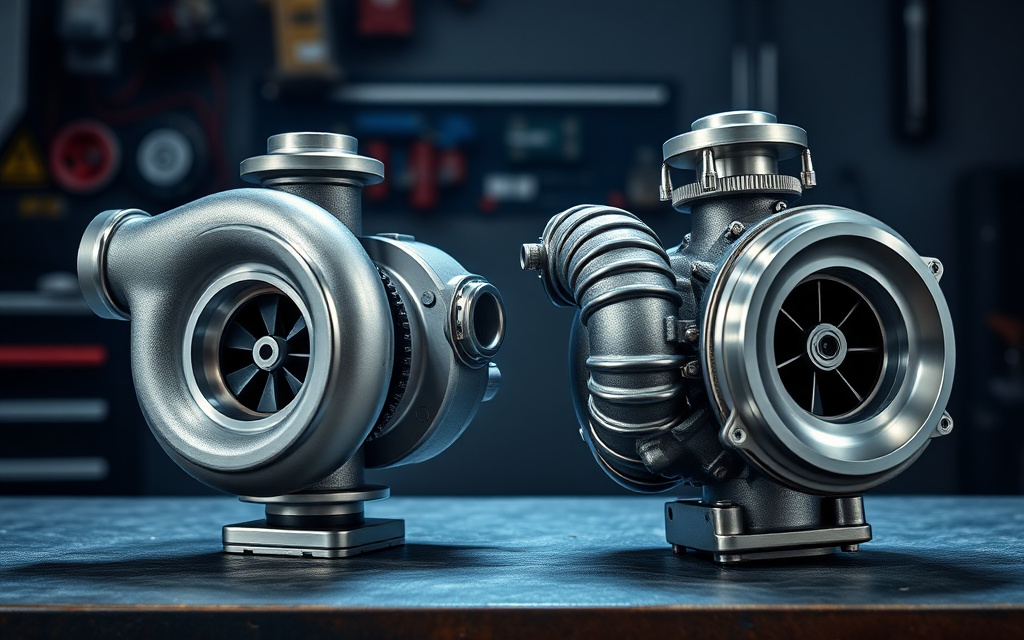
Turbo vs. Supercharger: Which Upgrade Is Right for You?
Forced induction is one of the most impactful upgrades you can make to a naturally aspirated engine, but the turbo-vs-supercharger question trips up a lot of first-time builders. Both force more air into the engine to make more power, but they get there in fundamentally different ways — and that difference shapes everything from how the power feels to how much the whole project costs.
How Each One Actually Works
A turbocharger uses exhaust gas to spin a turbine, which drives a compressor that forces air into the intake. Because it relies on exhaust flow, power delivery ramps up as engine RPM (and exhaust flow) increases — this is the source of "turbo lag," the brief delay between pressing the throttle and feeling full boost.
A supercharger is mechanically driven directly off the engine's crankshaft via a belt, so it starts compressing air the moment the engine is running, regardless of exhaust flow. That means power delivery is immediate and linear, without the lag characteristic of a turbo setup.
Power Delivery: Immediate vs. Building
This is usually the single biggest factor in how a turbo or supercharger feels to drive. A supercharger gives you power right off idle, building smoothly and predictably as you press the throttle — a lot of builders describe it as feeling more "connected" to the pedal.
A turbo setup, especially a larger single-turbo kit built for peak power, can have a noticeable lag at low RPM before boost comes on, followed by a strong surge as the turbo spools up. Modern turbo kits — especially twin-scroll or twin-turbo setups sized appropriately for the application — have significantly reduced this lag compared to older designs, but it's still a fundamentally different power delivery character than a supercharger.
If you're building a daily driver where low-end responsiveness matters, or a track car where predictable, linear power delivery makes it easier to drive at the limit, a supercharger's characteristics are worth serious consideration. If you're chasing peak horsepower numbers, especially at higher RPM, or you want the classic turbo power surge, a well-sized turbo kit is hard to beat.
Efficiency and Heat
Because a supercharger draws mechanical power directly from the engine to spin the compressor, it's less efficient in a strict sense — some of your engine's own output is spent driving the supercharger itself. A turbo, by contrast, is powered by exhaust gas that would otherwise be wasted, making it inherently more efficient from a pure power-per-fuel standpoint.
Turbos also run hotter, since they're directly coupled to hot exhaust gas — this is why turbo kits typically require more attention to heat management (intercoolers, heat shielding) than supercharger kits, which generate heat primarily from air compression rather than exhaust exposure.
Installation Complexity and Cost
Turbo kits generally involve more complex installation — exhaust routing, oil and coolant lines to the turbo, intercooler piping, and often more extensive tuning to manage boost curves safely across the RPM range. This typically translates to a longer installation time and, in many cases, a higher total installed cost, especially for custom or high-end turbo setups.
Supercharger kits, particularly bolt-on kits designed for specific platforms, tend to be more straightforward to install since they don't require exhaust modification and often come as more complete, application-specific kits. That said, "straightforward" is relative — both upgrades require careful installation and professional tuning to be done safely.
Reliability Considerations
Both turbochargers and superchargers are reliable when properly sized for the application, installed correctly, and tuned conservatively for the supporting hardware (fuel system, engine internals, cooling). Problems with either typically trace back to running boost levels beyond what the supporting parts can safely handle, rather than an inherent reliability difference between the two technologies.
This is exactly why professional tuning matters so much with any forced-induction install — a dyno tune ensures air-fuel ratios, ignition timing, and boost targets are set appropriately for your specific combination of parts, rather than guessed at.
Which One Should You Choose?
There's no universally "better" option — it comes down to what you're building for:
Choose a turbo if: you want maximum peak power potential, you're building toward track or drag use where peak numbers matter most, or you specifically like the turbo power-delivery character.
Choose a supercharger if: you want immediate, predictable power delivery for daily driving or spirited street use, you want a simpler installation with less exhaust-side complexity, or you're prioritizing linear throttle response over outright peak numbers.
Financing Either Upgrade
Whichever direction you go, both turbo and supercharger kits — along with the supporting parts and professional tuning — can be financed together as a single purchase, so you're not stuck doing the install now and the tune later once you've saved up again. Apply for financing to see what's available for your build, or check out our full Performance Upgrades page for more detail on what's covered.